Warehouse Safety and PPE Guide: Forklift Safety, Pedestrian Separation and Essential Warehouse PPE
By Pujan Thakkar
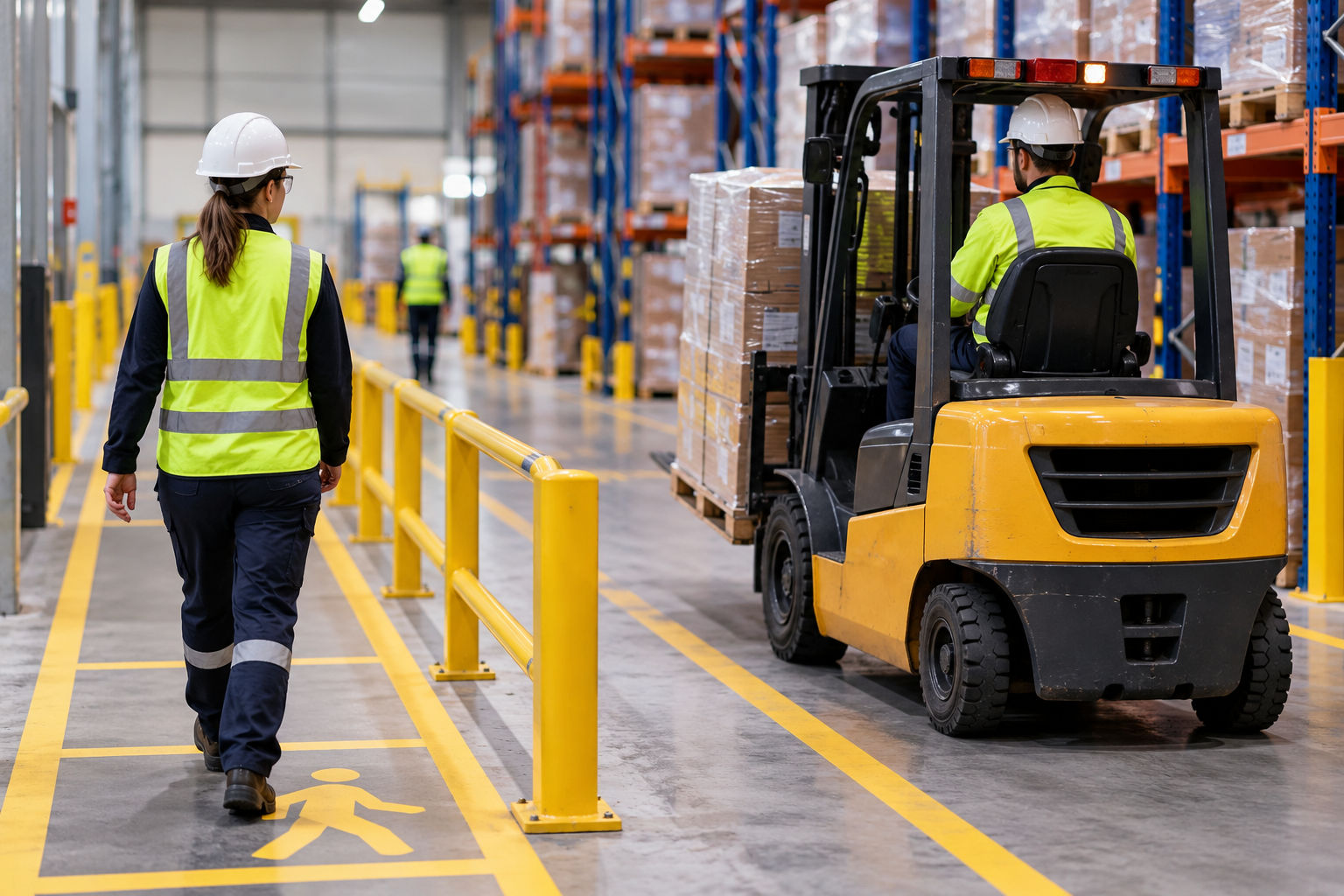
Warehouses are fast-moving workplaces where people, forklifts, pallet movers, delivery vehicles, storage systems and goods may operate within a relatively compact area. This combination makes warehouse safety a practical management priority rather than simply a compliance exercise.
A safe warehouse depends on much more than asking employees to be careful. Workplace layout, forklift traffic management, pedestrian separation, operator competency, load stability, housekeeping, supervision and correctly selected personal protective equipment all need to work together.
This warehouse safety and PPE guide explains some of the most important considerations for businesses operating warehouses, distribution centres, manufacturing stores, logistics facilities and industrial storage areas. Particular attention is given to forklift safety, pedestrian separation and essential warehouse PPE because these controls often interact directly with everyday warehouse operations.
Why Warehouse Safety Requires a Systematic Approach
Warehouse work can involve multiple hazards at the same time. A worker picking stock may be exposed to moving forklifts, falling objects, sharp packaging materials, manual handling risks, slippery surfaces and vehicle movements within a single shift.
Trying to manage each hazard in isolation can leave gaps. Effective warehouse safety therefore starts by looking at how the entire workplace operates.
Important questions include:
- Where do forklifts and other mobile plant travel?
- Where do employees, contractors and visitors walk?
- Where do pedestrians and vehicles potentially cross paths?
- Are blind corners or restricted visibility present?
- How are trucks loaded and unloaded?
- Are pallets and stored goods stable?
- What PPE is required in each operating area?
- Are workers trained for the tasks they perform?
- How are damaged equipment, unsafe pallets or spills reported?
The answers can form the basis of a practical warehouse safety plan and help identify where physical changes, procedures, training or PPE are required.
Forklift Safety Is a Major Warehouse Priority
Forklifts are extremely useful for moving materials, but they introduce significant risks when they operate near people.
Typical forklift hazards include collisions with pedestrians, collisions with structures or other vehicles, loads falling from forks, forklift tip-overs, poor visibility around loads, excessive speed and unsafe loading or unloading practices.
A key principle of forklift safety is that pedestrians and moving forklifts should not be expected to safely occupy the same space purely through attention, eye contact or informal workplace habits.
Where reasonably practicable, warehouse design should physically separate people from forklifts.
Pedestrian Separation: One of the Most Important Warehouse Controls
Physical pedestrian separation provides a more reliable control than floor markings alone because it reduces the opportunity for a person to accidentally enter the path of mobile plant.
Depending on the facility, separation measures may include:
- Fixed pedestrian barriers or guardrails
- Dedicated pedestrian walkways
- Pedestrian gates at crossing points
- Vehicle exclusion zones
- Pedestrian-only areas
- Protected waiting areas for truck drivers
- Bollards around vulnerable workstations
- Separate entrances for people and vehicles
Floor markings remain useful for communicating traffic routes, crossing points and restricted areas, but businesses should avoid treating paint as a substitute for physical separation where a stronger engineering control is reasonably practicable.
Review Common Crossing Points
Special attention should be given to locations where forklifts and pedestrians are more likely to interact.
Examples include:
- Warehouse entrances and exits
- Break rooms and amenities
- Time clock areas
- Picking and packing stations
- Loading docks
- Dispatch areas
- Battery charging areas
- Doorways between production and warehouse areas
- Blind intersections between storage aisles
If employees need to cross forklift routes regularly, the workplace should examine whether the workflow can be redesigned to reduce the number of crossings.
Develop a Warehouse Traffic Management Plan
A traffic management plan provides a structured way to control interactions between pedestrians, forklifts, trucks and other mobile equipment.
The plan should reflect the actual workplace rather than relying on a generic document.
A practical warehouse traffic management plan may address:
- Forklift travel routes
- Pedestrian pathways
- Loading and unloading zones
- Vehicle entry and exit points
- Pedestrian crossing locations
- Speed controls
- Blind corners
- Parking locations
- Truck driver waiting areas
- Temporary work zones
- Visitor movement
- Emergency access requirements
The plan should also account for changes. A warehouse layout that was safe when the facility opened may become unsuitable after additional racking, new equipment, increased stock levels or higher vehicle traffic.
Control Forklift Speed and Visibility
Forklift speed should suit the environment, load, floor condition, visibility and likelihood of interaction with people or other equipment.
Operators should have sufficient visibility to identify hazards and stop safely. Loads that obstruct forward visibility require appropriate operating methods and procedures.
Other controls can include:
- Convex mirrors at blind intersections
- Improved warehouse lighting
- Reversing alarms
- Warning lights
- Proximity detection systems
- Speed limiting systems
- One-way traffic routes where practical
- Removal of unnecessary visual obstructions
Technology can assist with risk reduction, but it should support good workplace design and safe systems of work rather than replacing them.
Forklift Operator Training and Competency
A safe forklift is only one part of forklift safety. The person operating it must also have the required competency, instruction and authorisation for the work being performed.
Training should extend beyond basic vehicle operation. Operators should understand site-specific conditions including traffic routes, speed requirements, restricted areas, pedestrian crossings, loading procedures, battery charging or refuelling arrangements and emergency procedures.
Workers who do not operate forklifts also require instruction if they work in areas where forklifts operate.
Forklift pedestrian safety training should explain:
- Where pedestrians are permitted to walk
- Areas pedestrians must not enter
- How designated crossings are used
- Why approaching an operating forklift can be dangerous
- How to remain visible to operators
- Where truck drivers and visitors should wait
- How hazards and near misses should be reported
Contractors, temporary workers and visitors should also receive appropriate site information before entering operational warehouse areas.
Safe Forklift Loads and Material Handling
Load stability is another critical part of warehouse safety.
Forklifts should move loads that are suitable for the equipment and properly positioned. Unstable pallets, damaged packaging and poorly secured goods can create risks for the operator and anyone nearby.
Warehouse teams should look for:
- Damaged pallets
- Unbalanced loads
- Loose cartons
- Overhanging goods
- Damaged wrapping
- Loads that interfere with visibility
- Unexpected changes in load weight or dimensions
Employees should not attempt to manually stabilise a load while a forklift is moving or lifting it. Procedures should make it clear how unsafe loads are isolated and corrected before transport.
Loading Dock and Truck Safety
Loading and unloading areas are particularly important because warehouse forklifts, road vehicles, drivers and other workers may all operate within the same environment.
Truck drivers should have a clearly defined safe location during loading and unloading. Where appropriate, protected driver safety zones can keep drivers away from moving forklifts while still allowing them to monitor loading activities.
Warehouse procedures should also address:
- Vehicle immobilisation where required
- Dock condition
- Trailer stability
- Communication between forklift operators and drivers
- Pedestrian access to the loading zone
- Safe movement around curtains, doors and tailgates
- Lighting during early morning or night operations
Essential Warehouse PPE
Personal protective equipment forms an important part of warehouse safety, but PPE should generally support higher-level controls rather than act as the only protection against a hazard.
The appropriate warehouse PPE depends on the tasks and hazards identified at the site.
1. High-Visibility Workwear
High-visibility clothing can improve worker visibility in warehouses where forklifts, trucks or other mobile equipment operate.
Garments should be appropriate for the working environment and applicable regulatory requirements. The design also needs to remain practical for the employee's tasks and working conditions.
High-visibility workwear may include:
- High-visibility shirts
- High-visibility polos
- High-visibility vests
- High-visibility jackets
- Reflective workwear where required
Visibility garments should be kept clean enough for the high-visibility material to perform effectively and should be replaced when excessive fading, contamination or damage reduces their usefulness.
2. Safety Footwear
Warehouse employees may be exposed to dropped goods, pallet edges, trolley wheels, slippery floors or sharp objects.
Suitable safety footwear can provide protection based on the identified risks. Features may include toe protection, slip-resistant soles, penetration resistance or other task-specific properties.
Footwear selection should consider the floor surface, working environment and duties performed rather than selecting footwear solely by appearance.
3. Work Gloves
Warehouse workers regularly handle cartons, pallets, wrapping, metal components and other materials that can cause abrasion, cuts or splinters.
Gloves should match the task. A general handling glove may be suitable for carton handling, while another activity involving sharp metal edges may require a higher level of cut protection.
The glove must also allow sufficient grip and dexterity for the work being performed.
4. Eye Protection
Safety glasses or other eye protection may be required where employees are exposed to dust, strapping, flying particles, chemical products, maintenance work or particular packing and processing activities.
Eye protection should be selected according to the hazard rather than applied as a one-size-fits-all solution.
5. Head Protection
Some warehouse environments may require safety helmets where there is a risk of falling objects, overhead work or particular industrial operations.
Head protection requirements should be established through the site's risk assessment and clearly communicated at entry points to relevant work areas.
6. Hearing Protection
Warehouses containing machinery, automated equipment, compressors or adjoining manufacturing operations may have areas where occupational noise requires additional controls.
Where hearing protection is needed, the correct type and level should be selected based on the actual noise exposure and applicable workplace requirements.
PPE Must Not Replace Forklift Separation
High-visibility clothing is useful for improving conspicuity, but a visible pedestrian can still be struck by a forklift.
This distinction is important.
Warehouse PPE should support an effective traffic management system that prioritises elimination, isolation and engineering controls wherever reasonably practicable.
A strong warehouse safety system may therefore combine fixed barriers, pedestrian walkways, safe crossing points, speed controls, trained operators, high-visibility clothing and supervision.
These controls work together, but they do not all provide the same level of protection.
Racking and Falling Object Safety
Warehouse safety also depends on the condition and use of storage systems.
Racking should be appropriate for the goods being stored and protected against foreseeable damage from forklifts and other mobile equipment.
Warehouse inspections should look for:
- Damaged uprights
- Bent structural components
- Missing or damaged protection
- Unstable pallets
- Goods extending unsafely into aisles
- Overloaded storage locations
- Damaged pallet supports
- Products at risk of falling
Suspected structural damage should be reported and assessed rather than ignored because the racking still appears to be standing.
Housekeeping and Slip Prevention
Good housekeeping is one of the simplest warehouse safety measures, but it requires consistent attention.
Pedestrian routes and forklift aisles should remain free from unnecessary packaging, straps, pallets, waste and other obstacles.
Spills should be addressed promptly using suitable procedures. Poor housekeeping can create slip and trip risks for pedestrians while also affecting forklift stability and braking.
Warehouse teams should establish clear locations for:
- Empty pallets
- Waste packaging
- Damaged goods
- Cleaning equipment
- Returned stock
- Quarantined products
When everything has a defined location, unsafe temporary storage is easier to identify.
Manual Handling in Warehouses
Not every warehouse injury involves a forklift.
Picking, packing, lifting, carrying, pushing and pulling can expose employees to musculoskeletal risks, especially when work is repetitive or loads are awkward.
Businesses should review whether manual handling can be reduced through better workstation design, lifting aids, conveyors, pallet positioning, height-adjustable equipment or changes to packaging.
PPE such as gloves may improve grip or protect the hands, but it does not eliminate the underlying risks associated with excessive force, poor lifting height or repetitive movement.
Warehouse Safety Checklist
A warehouse safety checklist can support routine inspections and help supervisors identify changes before they contribute to an incident.
A useful inspection should examine the real condition of the workplace rather than becoming a simple box-ticking activity.
Forklifts and Mobile Plant
- Are forklifts in serviceable condition?
- Are pre-operation inspections being completed?
- Are operators appropriately trained and authorised?
- Are travel routes clear?
- Are speed controls appropriate?
- Are warning devices functioning?
Pedestrian Safety
- Are pedestrian routes clearly defined?
- Are physical barriers in good condition?
- Are crossing points controlled?
- Are blind corners managed?
- Are visitors given safety instructions?
Storage and Racking
- Is racking visibly damaged?
- Are pallets stable and in good condition?
- Are loads stored safely?
- Are rack protection systems intact?
- Are aisles free of protruding stock?
Warehouse PPE
- Is required PPE available?
- Is the PPE appropriate for each task?
- Are employees wearing it correctly?
- Is damaged PPE replaced?
- Are high-visibility garments sufficiently clean and visible?
General Workplace Conditions
- Are floors clean and in good condition?
- Are emergency routes unobstructed?
- Is lighting adequate?
- Are spills controlled quickly?
- Are damaged pallets removed from service?
- Are loading areas organised?
Learn From Near Misses
A near miss can reveal a weakness in a warehouse safety system before someone is injured.
For example, a pedestrian unexpectedly stepping into a forklift aisle may indicate poor barrier design, an inconvenient pedestrian route, inadequate visibility, unclear rules or a workflow that encourages shortcuts.
Simply reminding the employee to be more careful may fail to address the underlying issue.
Near misses should therefore be reviewed for opportunities to improve workplace design, systems of work, training or equipment.
Review Warehouse Safety When Operations Change
Warehouses rarely remain static.
New customers, additional stock, seasonal peaks, extra forklifts, altered racking and new production processes can all change the site's risk profile.
Traffic management and PPE requirements should be reconsidered when significant operational changes occur.
Common triggers for review include:
- Installation of new racking
- Introduction of new forklifts or mobile plant
- Warehouse expansion
- Changes to loading dock arrangements
- Higher pedestrian traffic
- Introduction of night shifts
- New chemicals or products
- A forklift incident or near miss
- Changes to applicable workplace requirements
Building a Stronger Warehouse Safety Culture
Physical controls and PPE are most effective when supported by consistent workplace behaviour.
Supervisors should respond when unsafe shortcuts become normalised. Employees should be encouraged to report damaged barriers, poor visibility, unsafe loads and other hazards without waiting for an incident.
Regular toolbox discussions can focus on practical issues observed in the facility, such as forklift and pedestrian interactions, damaged pallets, loading dock safety or PPE condition.
The objective is to make safe warehouse operation part of routine work rather than something considered only during inspections or after an incident.
Choosing Warehouse PPE for Your Workforce
Businesses purchasing industrial PPE should start with the hazard and work backwards to the product.
Consider the task, environment, relevant standards, exposure duration, garment visibility, worker comfort, compatibility with other PPE and maintenance requirements.
For larger organisations, consistent PPE specifications can also simplify purchasing, replacement and workforce compliance.
Triotex develops industrial workwear and protective clothing solutions for demanding work environments, while PPE CART provides access to PPE and workplace safety products for industrial users.
Whether selecting high-visibility workwear, protective garments, gloves, safety footwear or other workplace PPE, the product specification should always match the actual risk assessment and applicable workplace requirements.
Conclusion
Warehouse safety is strongest when risks are controlled systematically rather than relying on individual caution.
Forklift safety should begin with workplace design and pedestrian separation. A practical traffic management plan should then control vehicle routes, pedestrian movement, loading areas, crossings, speed and visitor access.
Essential warehouse PPE such as high-visibility workwear, safety footwear, gloves, eye protection and other task-specific equipment adds another layer of protection, but PPE should not be used as a replacement for stronger controls where those controls are reasonably practicable.
Regular inspections, warehouse safety checklists, operator training, safe loading procedures, good housekeeping and review of near misses can help keep the system effective as operations change.
For warehouse operators, manufacturers, logistics businesses and industrial facilities, the goal is straightforward: design the workplace so people, vehicles and materials can move efficiently without unnecessary exposure to preventable risks.
About the author
Pujan Thakkar is building Triotex and PPE CART with a focus on industrial workwear, PPE, product strategy, manufacturing, growth, and partnerships. He writes about FR workwear, hi-vis standards, white label manufacturing, and practical supply programs for industrial buyers.